
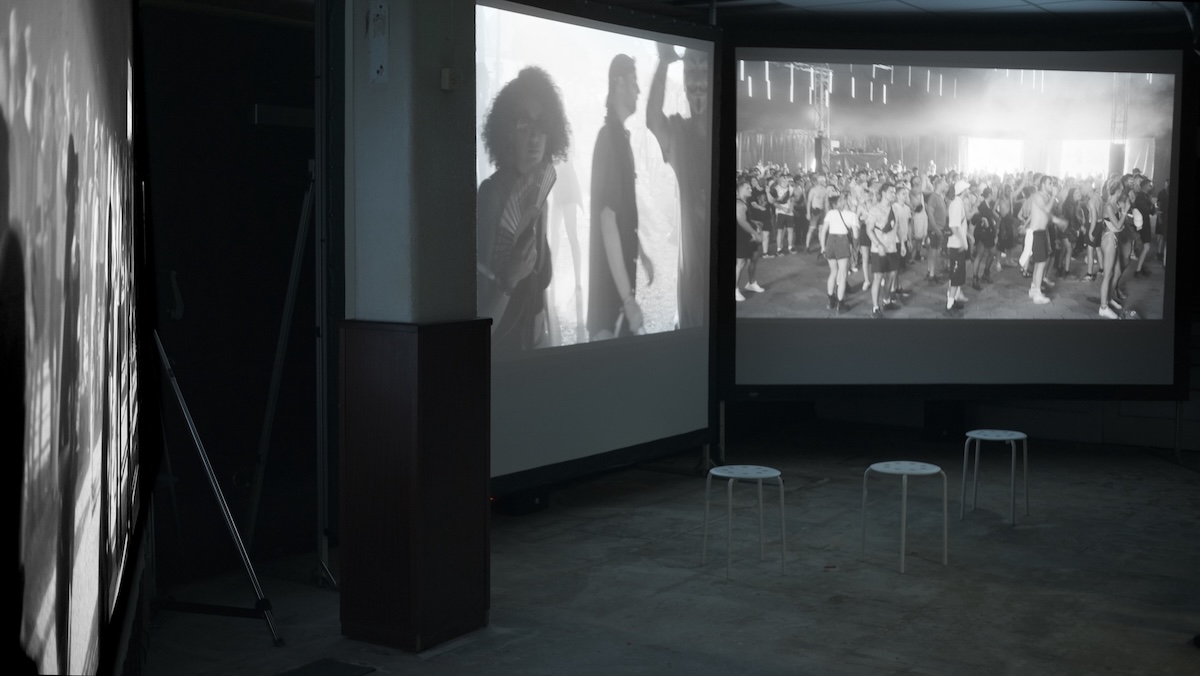
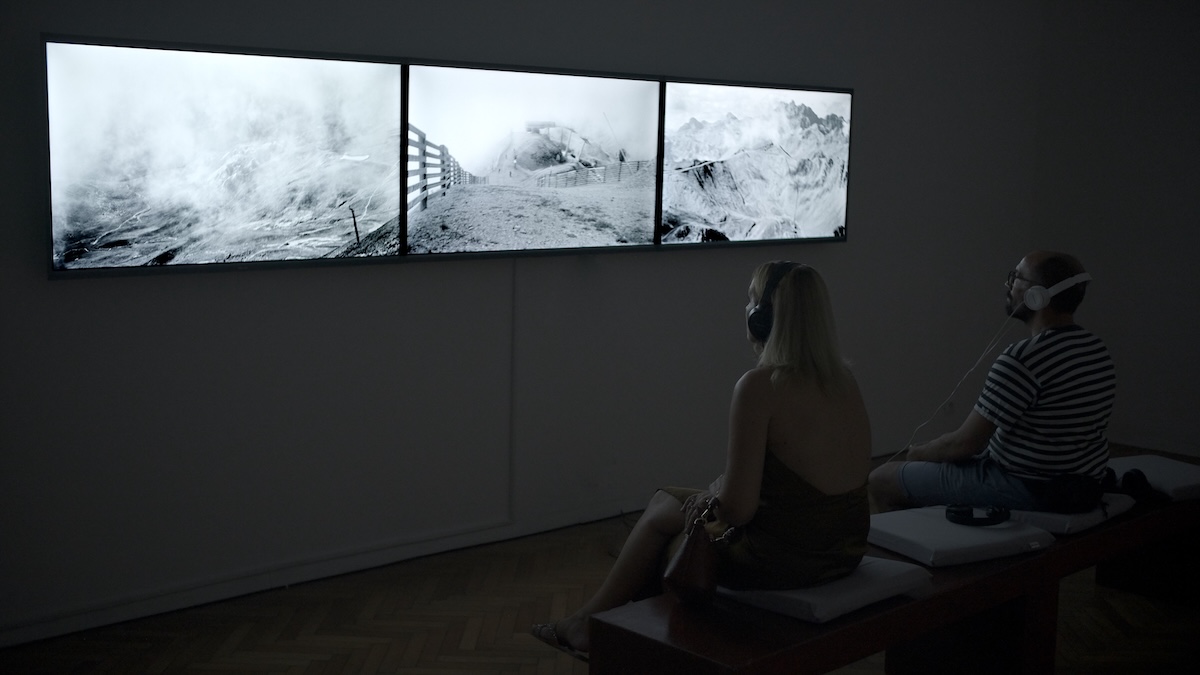
TOURIST | 3-channel-installation | 35:30 minutes, loop | 2026
Tourists observe places. Places observe tourists. The installation TOURIST shows both perspectives – simultaneously, across three screens, on a continuous loop. Angela Bedekovic and Matthias Grunsky explore the contradiction between individual longing and the realities of mass tourism. The work reflects a fundamental tension: the desire to travel and visit landmarks alongside the knowledge of disappointed expectations and ecological consequences. Three projectors play onto three screens, each with its own speaker and dedicated sound track. The projections are autonomous yet respond to one another in their editing rhythms, unfolding their effect through the interplay of image, rhythm, sound, and spatial arrangement. The audience sits, stands, or moves through the space – much like tourists themselves – suspended between contemplation, reflection, and the urge to move on.
Fujifilm X-T3 | 1.85 :1 | b&w | Filming Locations: Austria, Belgium, France, Germany, Italy, Luxembourg, Netherlands, Switzerland
Split Film Festival | Winner Grand Prix Media Arts Programme I Split, Croatia | 2026
artspace bremerhaven | Bremerhaven, Germany | 2026
Excerpt statement jury members Split Film Festival 2026 | Branka Benčić, Vuk Ćosić, Jasminka Babić
The work is offering a complex exploration of issues surrounding the representation of identity and place. It serves as a sophisticated study of the gaze, capturing the intersection of human behaviour and landscape representation. It views tourism and tourists not merely as a subject matter, but as a framing device through which codes of identity – such as images of place, national and other identities, and forms of belonging – are produced and reproduced. The focus often shifts away from individual tourists to the crowd as a collective body that moves, observes, poses, consumes, and participates in rituals of spatial commodification. In this way, the installation TOURIST creates an experience bordering on the uncanny: we recognise specific tourist situations and locations – whether distinct sites or metonyms for places – yet we observe them as settings for a collective ritual. The three-channel structure further fragments and multiplies the gaze, generating a sense of simultaneity and a certain unease in the face of scenes involving the mass movement of bodies, camera motion, and the consumption of space. Thus, the film transcends the conventional documentary portrayal of tourism to become a reflection on how we view places, prompting us to consider our own roles within the various spatial practices associated with tourists and tourism.